
Public Water and Wastewater Facilities Design in Texas: What Developers and Municipal Clients Should Know

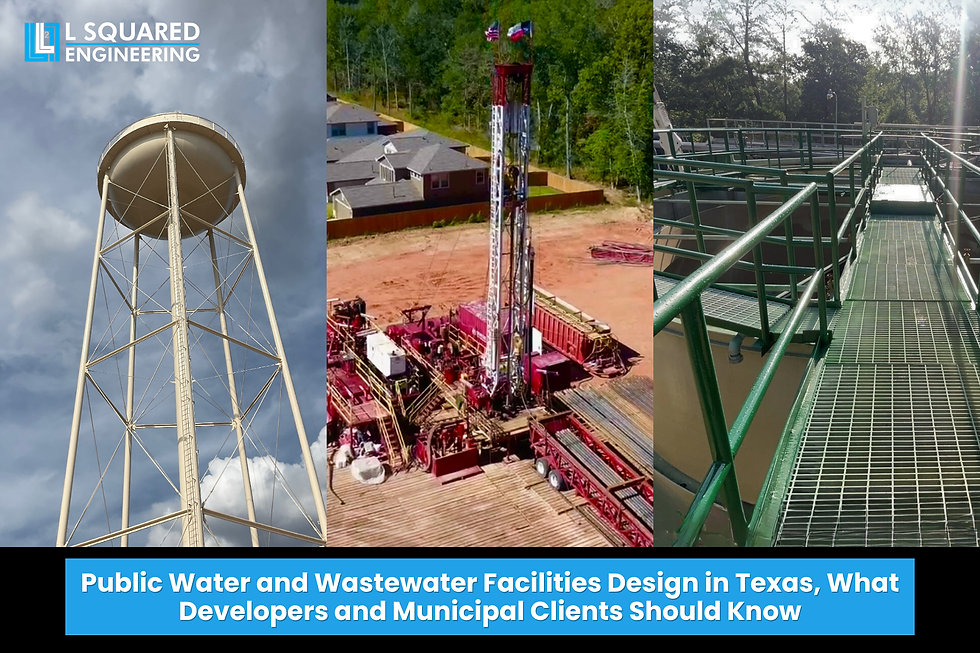
Public water and wastewater infrastructure can determine whether a development, municipal project, industrial facility, or public site can move forward as planned. Water supply, wastewater collection, system capacity, treatment needs, utility routes, permitting, and construction requirements all need to work with the larger civil design.
In Texas, these decisions become especially important when projects depend on new infrastructure, extensions to existing systems, or improvements that must serve several phases of development.
Developers and municipal clients benefit from addressing water and wastewater needs early. A site may have plenty of available acreage yet still face infrastructure constraints that affect building placement, project phasing, construction costs, or permitting.
Civil engineering connects infrastructure needs with land development, site design, drainage, roads, and the agencies responsible for project review.
Key Takeaways
Public water and wastewater facilities should be evaluated during early project planning.
Available infrastructure does not automatically mean adequate capacity exists for a proposed project.
Water supply, wastewater collection, utility routes, site layout, and permitting need to be coordinated together.
Texas projects may require review and approval from utility providers, municipalities, counties, TCEQ, or other agencies.
Early capacity planning can help prevent utility limitations from disrupting later phases of development.
What Public Water and Wastewater Facilities Design Includes
Public water and wastewater facilities design covers the infrastructure needed to provide reliable water service and manage wastewater for communities, developments, businesses, industrial properties, and public facilities.
Water infrastructure can include distribution lines, public water wells, drinking water facilities, storage, service connections, valves, and other system components.
Wastewater infrastructure can include collection lines, manholes, lift stations, treatment facilities, force mains, and related improvements.
For broader municipal and utility projects, our public water and wastewater facilities services connect these systems with the surrounding civil infrastructure.
The exact design depends on project demand, available systems, connection points, capacity, site conditions, and agency requirements.
Water Planning Begins With Demand and Available Service
Water system planning starts with the amount of service the project needs.
A commercial development, industrial facility, municipal property, and large land development can have very different demands. Domestic service may be only one part of that calculation. Fire protection, operating requirements, and future phases may also influence system planning.
Existing infrastructure should be reviewed early.
The presence of a water line near the property does not necessarily mean the project can connect without additional work. Engineers and project teams may need to evaluate line size, pressure, available capacity, connection locations, easements, and requirements established by the service provider.
If existing service cannot support the project, additional infrastructure may be required.
That can influence the site plan before detailed engineering begins.
Public Water Wells and Drinking Water Facilities Require Careful Coordination
Some projects cannot rely on an existing public water connection.
Public-use wells and drinking water facilities may be included in the infrastructure plan, depending on location and service needs.
Design can involve the well itself, pumping equipment, treatment needs, distribution infrastructure, site access, supporting facilities, inspections, and approval requirements.
Our water wells and drinking water plants services address design and permitting for public-use water systems.
These facilities should also be coordinated with roads, drainage, building areas, and maintenance access.
A technically suitable location can still create problems if operators cannot easily reach equipment or if future development surrounds an area that requires continued access to service.
Wastewater Needs a Practical Collection and Treatment Plan
Wastewater infrastructure needs a clear path from the source to the receiving or treatment system.
Where an existing public system is available, the project team may need to evaluate connection locations, system capacity, line elevations, extension requirements, and available routes across the property.
Gravity sewer systems depend heavily on elevation.
A connection that appears close on a map may become difficult if the site cannot achieve the necessary slope. In other situations, a lift station and a force main may be included in the design.
Larger public or development projects may also require new or improved treatment infrastructure.
Wastewater planning should therefore begin alongside the overall site layout rather than being added after buildings and roads are already in place.
Capacity Can Shape the Entire Development
Infrastructure capacity is directly related to land development.
A site may be planned for several buildings or multiple phases, but the available water or wastewater system may support only part of the proposed demand without improvements.
That does not automatically make the property unsuitable.
It means infrastructure and phasing need to be coordinated.
A first phase may use available capacity while later improvements support additional construction. Another project may benefit from installing certain utility infrastructure early so it can serve several future sections.
The important point is to identify these conditions before the first phase creates obstacles for the next one.
Water and wastewater capacity should support the project being built today while leaving reasonable options for planned future use.
Utility Routes Need to Work With Site Design
Water and wastewater infrastructure compete for space with nearly every other part of a site.
Utility lines may need to cross roads, parking areas, drainage systems, or other underground infrastructure. Easements can limit building locations. Manholes and valves need practical access. Lift stations and treatment facilities need areas that remain accessible after construction.
That makes utility planning an important part of site design.
Planning these systems together can reduce avoidable conflicts.
A wastewater line placed without considering finished grades may become too deep. A water line may interfere with proposed storm drainage. A utility corridor may pass directly through acreage intended for another phase.
Early coordination gives engineers more room to identify practical routes before pavement and building locations are finalized.
Texas Permitting Requirements Should Be Considered Early
Public water and wastewater projects can involve several reviewing organizations depending on the project and location.
TCEQ requirements may apply to public water systems, drinking water infrastructure, wastewater facilities, and related approvals. Cities, counties, utility districts, and service providers may also have their own standards.
Design and permitting should therefore move together.
Waiting until plans are nearly complete before reviewing agency requirements can lead to additional revisions.
A better process identifies likely approvals early and prepares the engineering documents with those requirements in mind.
This is also why documentation matters. Plans, calculations, reports, inspection records, certifications, and other project information may all become part of the approval and closeout process.
Infrastructure Needs Vary Across Texas Counties
Water and wastewater planning can look very different across Texas.
Projects in Fort Bend County may interact with established municipal or utility district systems. Waller County developments may require infrastructure extensions depending on location. Chambers County industrial or commercial projects may bring different service demands.
Liberty County and San Jacinto County can include larger properties where utility availability strongly influences early land planning. Walker County projects, including work around Huntsville, may involve municipal infrastructure, public facilities, commercial development, and institutional sites.
Galveston County adds another layer in which drainage, flood conditions, finished elevations, and utility infrastructure may require particularly close coordination.
These differences make local site review important. A solution that works for one Texas property should not automatically be carried over to another.
Construction Details Affect Long-Term Operation
Good utility design needs to carry through construction.
Pipe elevations, bedding, connections, valves, manholes, testing, access, and installation details all affect how the finished infrastructure performs.
Construction sequencing also matters.
Underground utilities generally need to be coordinated before the final pavement is laid. Utility crossings should be resolved before roads are complete. Drainage infrastructure needs to work with utility elevations rather than creating field conflicts.
Inspection and construction coordination help ensure that installed infrastructure complies with the approved plans.
The finished system needs to work after the construction crews leave.
Plan Water and Wastewater Infrastructure Early
Public water and wastewater facilities influence far more than utility drawings.
They can affect land development, building placement, road alignment, grading, site access, project phasing, permitting, and construction.
L Squared Engineering works with developers, municipal clients, public entities, and project teams across Texas to connect utility infrastructure with practical civil design.
If you are planning a development, municipal facility, utility improvement, or public infrastructure project, contact L Squared Engineering to discuss public water and wastewater facilities, capacity planning, permitting, and civil engineering requirements.


Comments